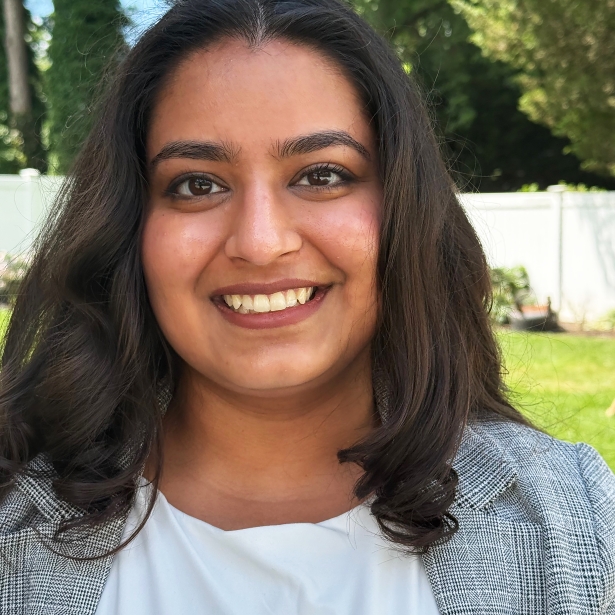
2025 Prize Recipient

Anaushka Goyal (MCP'26)

The Witte-Sakamoto Family Prize in City and Regional Planning

Anaushka Goyal is a Master of City Planning student at the University of Pennsylvania, focusing on spatial analytics. Her research centers on the emotional and affective dimensions of urban space, most notably through Lived Narratives, a project that surfaces how Philadelphians experience public spaces in ways often overlooked by traditional planning data.

At Penn, Anaushka is a research assistant to Professor Akira Rodriguez on a study examining the school facilities planning process in Philadelphia, with a focus on the deep community significance of schools facing closure. She is also an SNF Paideia Fellow, committed to interdisciplinary civic engagement and inclusive public dialogue.

In the summer of 2025, Anaushka is interning with Community Development Long Island as a Real Estate and Development Intern, contributing to a regional Zoning Atlas through the analysis of municipal zoning codes. Previously, she worked at the Urban Design Research Institute (UDRI) in Mumbai, where she contributed to an open space study that illuminated the disconnect between urban policy and lived realities.

Anaushka holds a Bachelor of Architecture from Sir J.J. College of Architecture, Mumbai. Her work lies at the intersection of real estate development, planning, and technology. She is driven by a belief that while data-informed policymaking is critical to addressing cities’ structural challenges, truly meaningful urban futures must also be rooted in efficiency, equity, belonging, memory, and trust. 

Weitzman School Awards: Anaushka Goyal (MCP'26)

Anaushka Goyal
  • Studying Philadelphia- This map highlights broadband access among Philadelphians under 18, an essential factor in determining who can meaningfully participate in digital mapping and share their everyday experiences online. (Visualisation was inspired by the artwork of Velvet Black Pixel)
  • Studying Philadelphia- This map illustrates access to laptops, tablets, and smartphones across Philadelphia, key tools for online participation. It reveals how digital access directly influences whose voices are heard in this project.
  • This map weaves together personal memories and emotions tied to the area, offering a layered, human perspective that raw data alone can’t capture. It’s not just about where things happened, but what those places meant to the people who lived them.
  • This map reveals how people feel in this space, beyond its physical form. Stories of calm sunsets, familiar benches, laughter, loss, and discomfort uncovered an emotional texture often missing from planning data. Mapping feelings like safety, joy, isolation, and nostalgia offered a deeper understanding of how people truly experience place.
  • The data shows clear emotional patterns by age and gender. Respondents aged 18–35 shared the widest range of feelings, from joy to discomfort. Older groups noted fewer emotions, often centered on nostalgia. The Sankey diagram reveals that creative acts and kindness, especially among women, were common, while harassment was rare. Most actions occurred daily or weekly, underscoring how routine moments shape emotional geographies.